Anatomy of a Crisis
Publicado el: Fri Oct 24
Written by Amadeos Oyagata Maigua, Dakota Santillan Teran, Sydney Males Muenala
Mapping the Social and Territorial Tensions in Otavalo, Ecuador
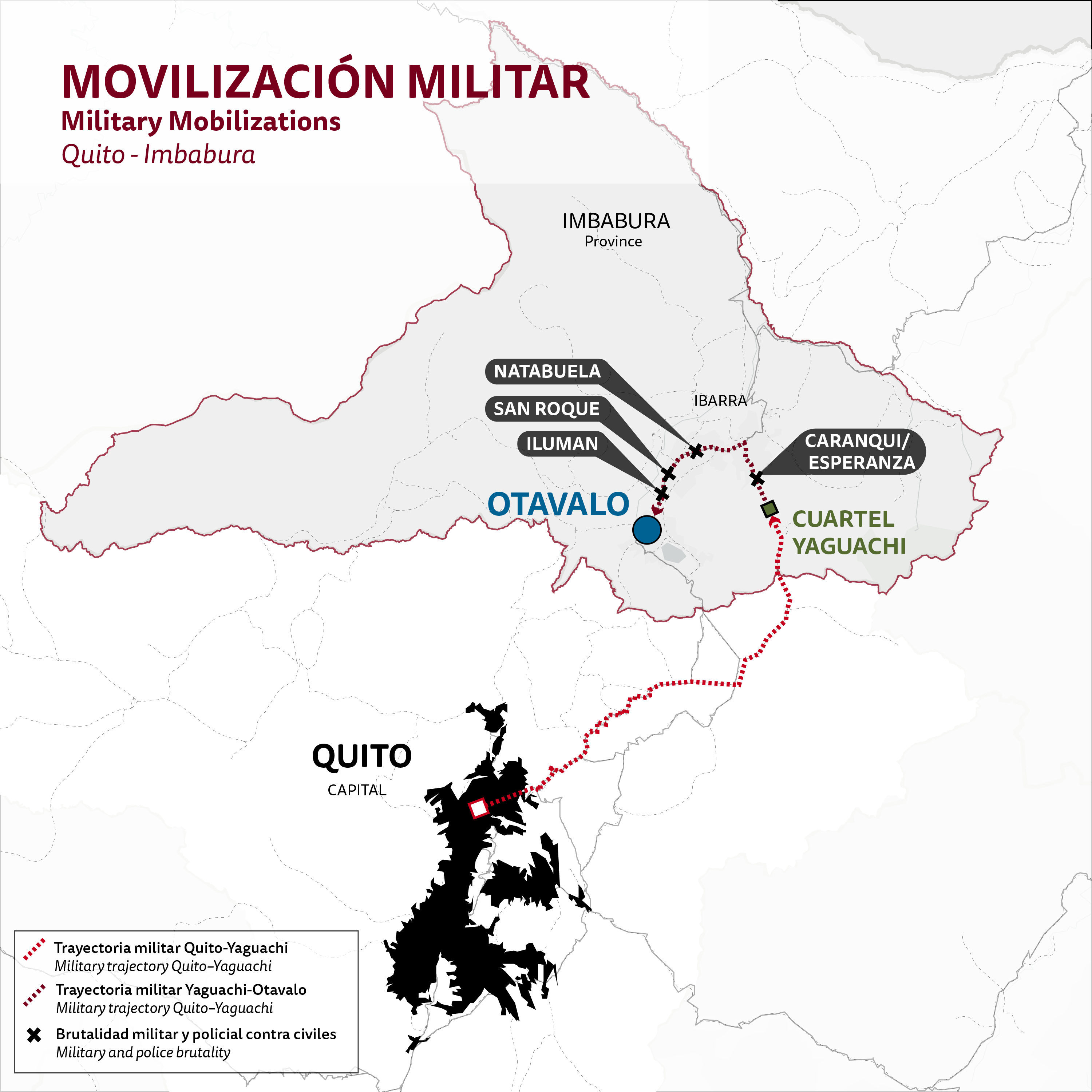
On October 13, 2025, the northern highlands of Ecuador awoke to the roar of military engines as a “Humanitarian Convoy” entered Olmedo, La Esperanza, and Pukuwayku—Indigenous territories central to communal life in Imbabura. Publicly presented as aid, the operation quickly escalated into a violent crackdown. Security forces deployed tear gas and pellets against protesters, injuring at least twenty-two people, including women and elders. That night the armed forces occupied the Colegio de Ibarra as a logistics base, revealing a premeditated deployment that preceded the larger incursion into Otavalo. The operation exceeded the limits of legitimate force and functioned as a political strategy of territorial control aimed at weakening Indigenous organization and identity.
Violence continued with raids on hospitals and health centers, forcing residents to set up improvised medical posts in Cotacachi, Peguche, and Carabuela. Human rights organizations documented 367 violations, 295 injuries, and 205 detentions. Among the victims was José Alberto Guamán, a 30‑year‑old Kichwa father fatally shot in Otavalo; his death became emblematic of the crisis. While authorities framed the mission as humanitarian, local communities recognized it as military repression and a violation of collective rights.
In response, Dakota Santillan (M.Arch, University of California Berkeley), Sydney Males (M.I.R & facilitator, Indigenous Council GARN), and Amadeos Oyagata (MUP, Harvard University) set out to document and spatialize the events. Through spatial analysis and community collaboration they verified geolocated data, images, and testimonies. The resulting maps reveal the geography of state violence between October 13–14, transforming dispersed evidence into a coherent spatial record for public understanding and accountability.